Showing posts with label Digital Print. Show all posts

Wednesday, November 14, 2018

Collecting Colours in Saigon

I had previously written about my recent digital print 'District 7 Strata', and how the work led on to further divergent threads that I am now beginning to unpick one by one. In addition to this I would like to express my satisfaction at having the opportunity of writing about my working process in more detail.

I had the pleasure of having an article accepted into the Lines of Desire section of the online journal LivingMaps Review.

I tried to describe my working process during the creation of the digital print and the decisions I made throughout. The editors of the Lines of Desire section, Blake Morris and Clare Qualmann enabled me to complete this article, refine it for publication and also to clarify my own thoughts into a more coherent state and for that I am extremely grateful.

The article can be read here.

Abstract

Maps are symbolic representations of chosen places, whether real or imagined and are constructed in ways that communicate specific information. Sometimes maps can be accurate geographic recreations of locations but often these relationships can be sacrificed if other information has been granted priority. The following article details the working process undertaken by Patrick S. Ford as he creates a digital print based upon a study of a district of Saigon (Ho Chi Minh City) in Vietnam. A period of familiarization of the district involving extended walks resulted in a piece of work that is essentially a map of the area under study.


Tuesday, August 21, 2018

Open-ended work

Following the completion of the digital print work 'District 7 Strata', 2018 there have emerged several new lines of investigation that have sprung from both the development phase and from the finished work.


'District 7 Strata', 2018


As the print is actually a map of the studied area in District 7, the first thing I did was to take a closer look at the layout of the streets, especially the road junctions / intersections. For each of the 34 junctions lying within the studied area, there is a corresponding colour that was collected on site and which eventually worked in conjunction with the shaded blocks surrounding it. The shaded blocks featured lines going in different directions according to a logic that was determined in previous work, vertical, horizontal and diagonal. 

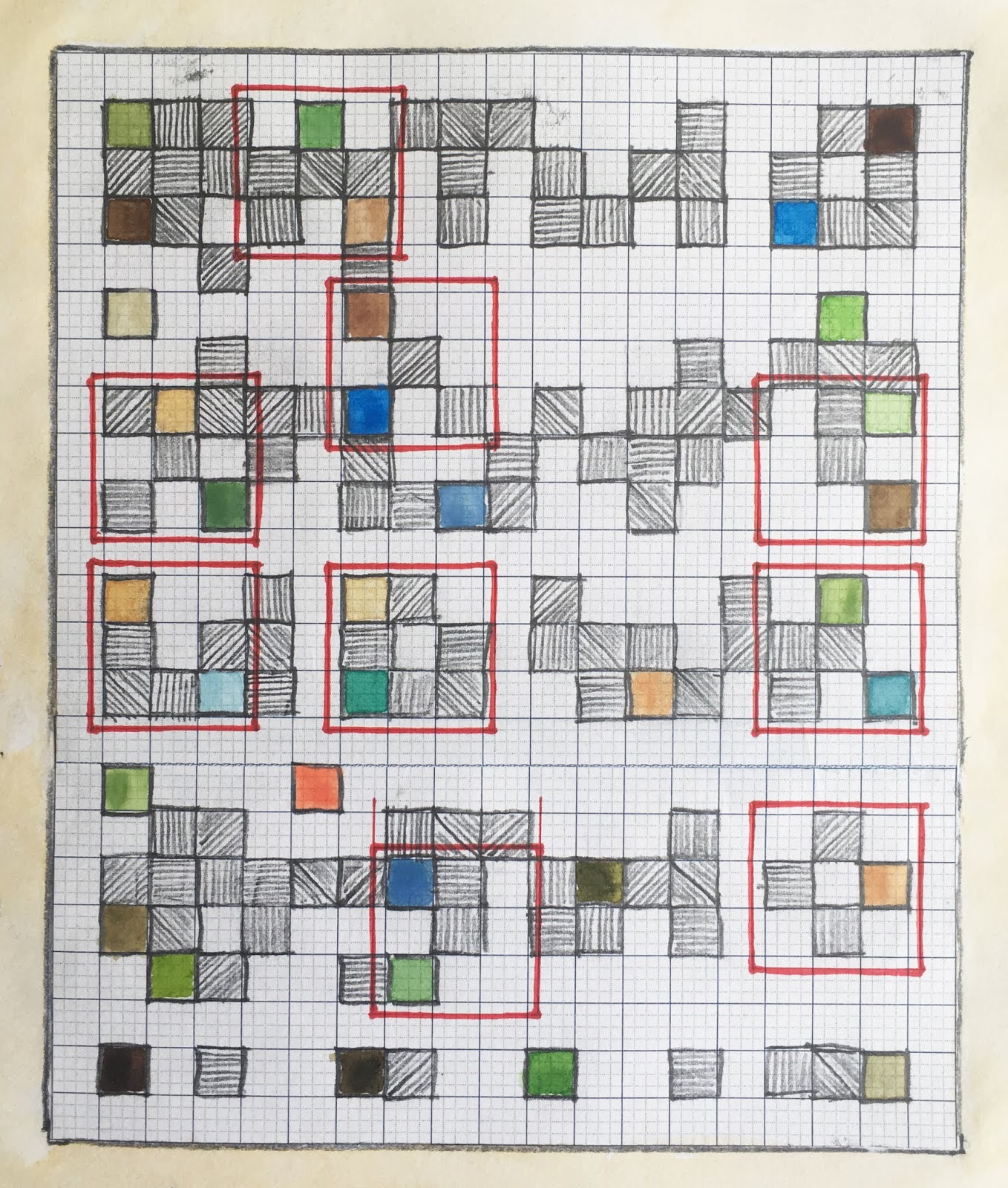
I noticed that the most interesting zones, where colours interacted with shaded blocks in different ways, constituted larger blocks made up of 9 squares as measured on the background grid. Having noticed these interesting zones, the first thing I did was to highlight them and look at them in greater detail.


The first selection of interesting 'zones' prior to print completion


I selected 9 zones of particular interest. The number was important as each zone was itself made up of 9 squares of the background grid. The selected zones are indicated in the notebook page drawing above.
Once the digital print had been resolved and the edition (x30) printed out, I reselected the 9 zones on a test proof, as seen below. This test proof was made on a cheap colour printer and therefore displays mistake that were not carried on to the final version printed for me by an output company.


Selected zones marked on the proof sheet


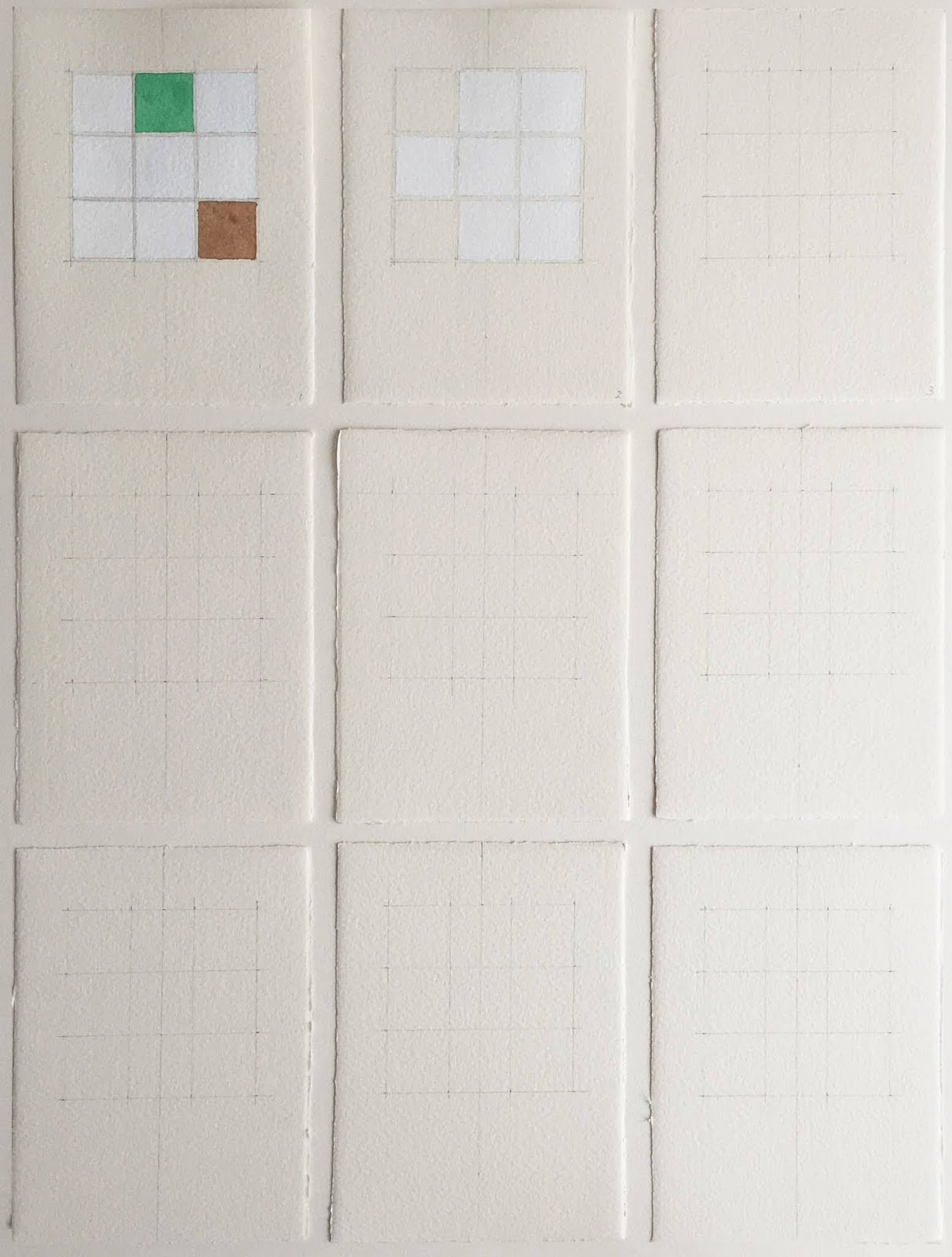
Two forward directions became apparent to me and both directions entailed working on larger versions of each zone. I happened to have a pack of small samples of Saunders Waterford cotton papers that I had been carrying around for a while and now their time had come. 
For the first direction I began working on the zones by laying watercolour down onto the Saunders sample sheets, starting from the top-left. Below is a very early stage archive photograph of the initial progress showing the initial layers of colour.


Painted investigation showing initial stage of work


The second direction arose after considering the physical nature of the mapped area and how the topography of the area was comprised of buildings of different heights interlaced by the roads and pavements. As the shaded blocks had different directions of hatching I devised a formulae that would determine the height of each block from a datum level: vertical hatching was assigned a value of 1, diagonal hatching from top right to bottom left was assigned a value of 2, diagonal hatching from top left to bottom right was assigned a value of 3 and horizontal hatching was assigned a value of 4. I could now work my way through the 9 selected zones and build them up into a relief structure according to the assigned heights and colours. 

The work on the relief pieces and the painted pieces would progress in tandem to allow any cross-fertilisation of influences to take place as the work developed.


Initial planning for relief structures (framing may not be retained)


Constructing blocks with the assigned values, adding white undercoat

As these two projects develop, I will later post updates to show the progress along with the resolved pieces of work. This work will be carried out alongside a couple of writing projects I am also engaged with.

Sunday, June 17, 2018

New location, new print work

After leaving Hong Kong in need of a break from the hectic life I first visited Vietnam and thought I would enjoy a brief sojourn in Saigon.

Exploring the city, I discovered an interesting area south of the city centre, which is otherwise an open area currently undergoing major redevelopment. In contrast to the rest of the local District, the small area I chose to study is comprised of small, tree-lined streets with many restaurants, cafes and other shops. The main reason I was attracted to this area is that while looking at a map of the area, I noticed a similarity to the grid-based drawings and prints I had been working on recently. The thought of a landscape study or even 'portrait' of the area began to develop.

I composed a plan in which colours would be collected at the intersections of the streets and overlaid on to my previous grid structure. If any colours happened to fall on the spot already occupied by a lined box, I would allow myself to move the colour to an adjacent spot. The decision of where to move the colour would be determined by my own judgement, based on the existing composition.
The overall composition would therefore be a combination of aesthetic judgement and system-imposed structure.

Notebook pages below:


I used the 'City Palette' app (which I had used before) to collect a colour at each of the 34 intersections in the area and dropped them into the grid structure I had constructed in Adobe Illustrator. I decided to move from A4 to A3 for the printing in line with my decision to gradually increase the scale of the work.


'District 7 Strata', 2018


One of the road junctions for colour collection


Sunday, June 18, 2017

Mini Print International of Cadaques 2017

From July 1st 2017, I will have the opportunity of exhibiting a recent small scale digital print in Europe. The 4 proofs I submitted allows for the work to be shown in multiple venues with overlapping exhibition dates and also in the hope of sales!

At the moment the exhibiting schedule is as follows: the first venue will be at Taller Galeria Fort at Cadaques, North Eastern Spain from July 1 - Sept 30 2017, then at Wingfield Barns in the UK from July 22 - Sept 3 2017, at Pineda de Mar in Spain from Oct 20 - Nov 12 2017, and finally at Galerie L'Etangd'Art in Bages, France from Nov 19 2017 - Jan 15 2018.

I am currently working on a series of prints, drawings and paintings that are developing out of this initial print. I will post more details about these as they are resolved.


Strata - 2017


Friday, February 10, 2017

Digital Print for exhibition

I had decided to participate in a mini-print exhibition after a brief gap, during which I had been developing a series of performance pieces, and began preliminary work on an image in several sketchbooks. As I worked, the image gradually increased in detail and it became clear to me that my original intended medium (linocut) would be unsuitable.
At this stage I moved onto my Mac and started anew on an image generated with Adobe Illustrator. This seemed to improve the development of the image and appeared to be the correct choice.

The image has now reached a kind of equilibrium and, as time is running out, I will find a digital printer to produce an inkjet edition for me. The initial quotes were surprisingly expensive so I may have to modify my expectations (a familiar process for me).

Unfortunately the print was not selected for exhibition this time. However, the process of working on it has opened up a new thread of investigation and the value of this for my work overall far outweighs participation in the mini-print exhibition.