Tuesday, August 21, 2018

Open-ended work

Following the completion of the digital print work 'District 7 Strata', 2018 there have emerged several new lines of investigation that have sprung from both the development phase and from the finished work.


'District 7 Strata', 2018


As the print is actually a map of the studied area in District 7, the first thing I did was to take a closer look at the layout of the streets, especially the road junctions / intersections. For each of the 34 junctions lying within the studied area, there is a corresponding colour that was collected on site and which eventually worked in conjunction with the shaded blocks surrounding it. The shaded blocks featured lines going in different directions according to a logic that was determined in previous work, vertical, horizontal and diagonal. 

I noticed that the most interesting zones, where colours interacted with shaded blocks in different ways, constituted larger blocks made up of 9 squares as measured on the background grid. Having noticed these interesting zones, the first thing I did was to highlight them and look at them in greater detail.
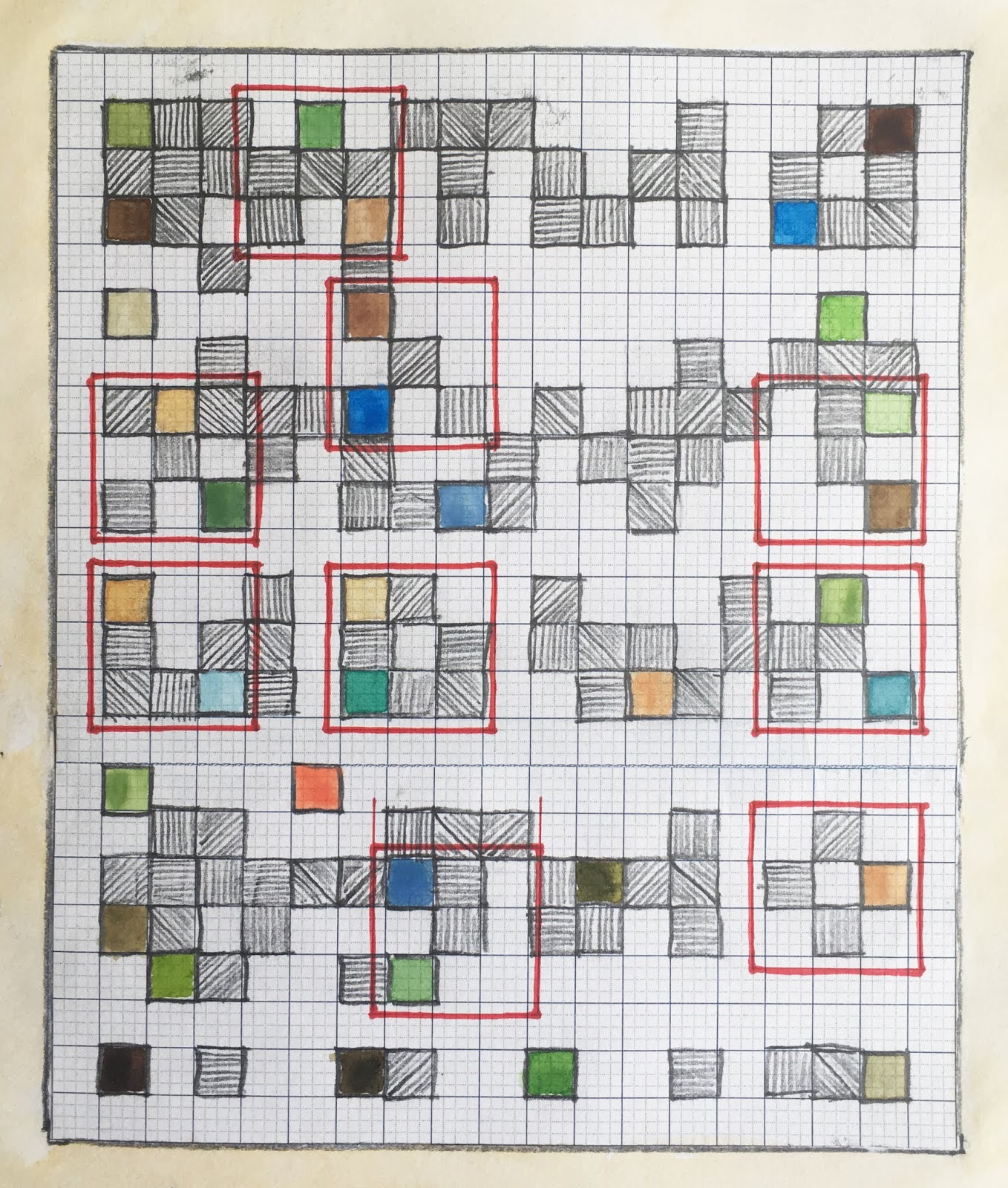

The first selection of interesting 'zones' prior to print completion


I selected 9 zones of particular interest. The number was important as each zone was itself made up of 9 squares of the background grid. The selected zones are indicated in the notebook page drawing above.
Once the digital print had been resolved and the edition (x30) printed out, I reselected the 9 zones on a test proof, as seen below. This test proof was made on a cheap colour printer and therefore displays mistake that were not carried on to the final version printed for me by an output company.


Selected zones marked on the proof sheet


Two forward directions became apparent to me and both directions entailed working on larger versions of each zone. I happened to have a pack of small samples of Saunders Waterford cotton papers that I had been carrying around for a while and now their time had come. 
For the first direction I began working on the zones by laying watercolour down onto the Saunders sample sheets, starting from the top-left. Below is a very early stage archive photograph of the initial progress showing the initial layers of colour.
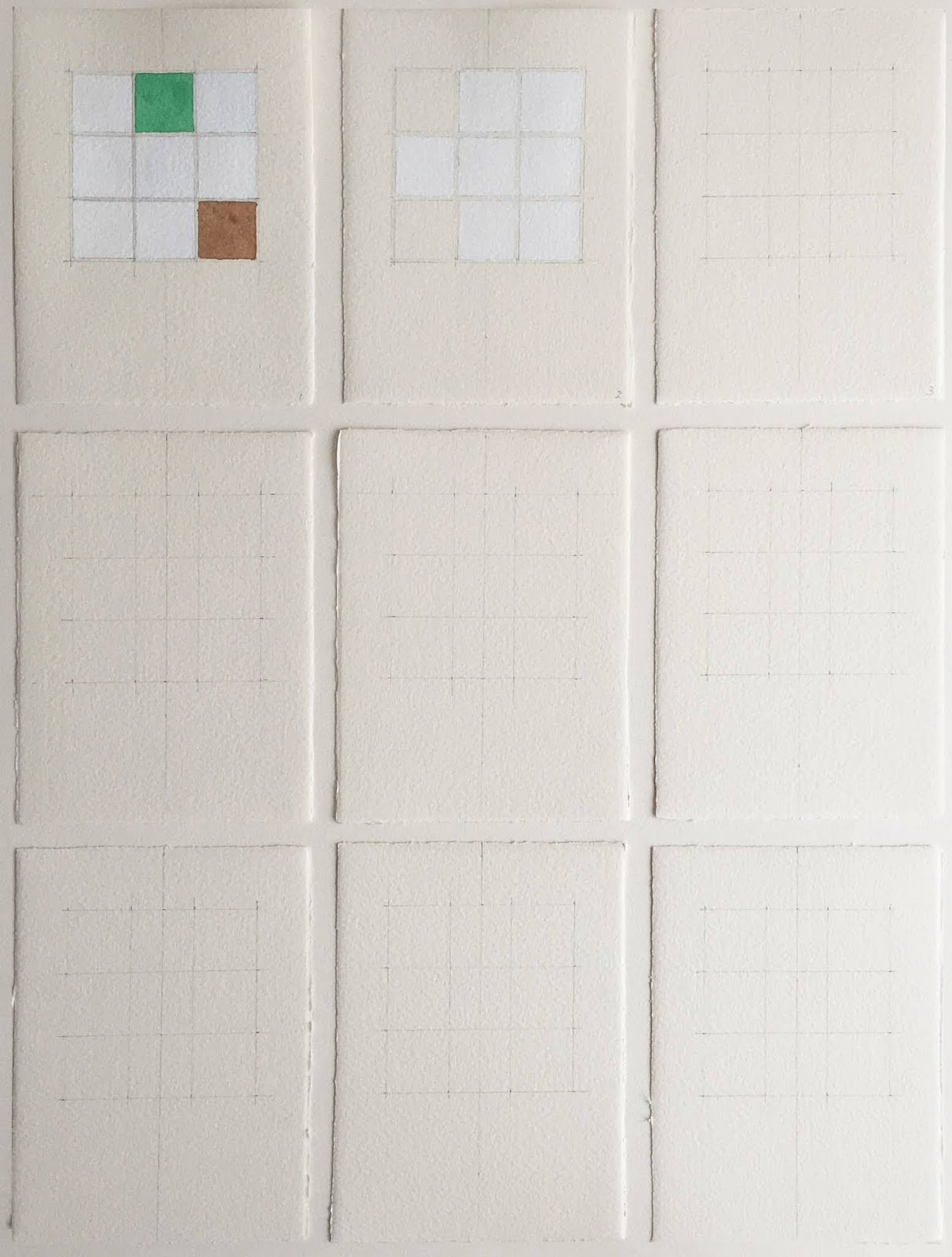

Painted investigation showing initial stage of work


The second direction arose after considering the physical nature of the mapped area and how the topography of the area was comprised of buildings of different heights interlaced by the roads and pavements. As the shaded blocks had different directions of hatching I devised a formulae that would determine the height of each block from a datum level: vertical hatching was assigned a value of 1, diagonal hatching from top right to bottom left was assigned a value of 2, diagonal hatching from top left to bottom right was assigned a value of 3 and horizontal hatching was assigned a value of 4. I could now work my way through the 9 selected zones and build them up into a relief structure according to the assigned heights and colours. 

The work on the relief pieces and the painted pieces would progress in tandem to allow any cross-fertilisation of influences to take place as the work developed.


Initial planning for relief structures (framing may not be retained)


Constructing blocks with the assigned values, adding white undercoat

As these two projects develop, I will later post updates to show the progress along with the resolved pieces of work. This work will be carried out alongside a couple of writing projects I am also engaged with.

Thursday, July 26, 2018

'Cities For People' - Ho Chi Minh City University of Architecture

The 1st Festival dedicated to Ho Chi Minh City Public Spaces runs from 25 - 29 July 2018 and as part of the festival I attended a keynote lecture given by Associate Prof. Camilla van Deurs - partner, Director & Team Lead Design at Gehl, Copenhagen, Denmark

Prof. van Deurs introduced us to the work of Gehl and how she and her team strive to put 'the life of public spaces first'.
The many examples she talked us through were stimulating and illustrated the attitude that has many times put Copenhagen at the top of world rankings for the world's most liveable cities. I was particularly interested in the point she made about how children are an important indicator of any public space. Wherever adults feel safe to let go of a child's hand, where they are allowed to run free, to play - then this is indeed a space that is safe and comfortable. Her practice put people first, which may not be a new idea but it certainly makes a refreshing change from the usual obsession with traffic.

Of course, Denmark is very different from Vietnam. In Saigon especially, the roads are bursting at the seams. During rush hour, pavements become additional lanes for motor-scooters and pedestrians need to take extra special care at these times. Work is still underway on the first line of the local Mass Transit Railway but when this single line opens in around 1-2 years, I predict it will not make much impact on the number of vehicles on the roads.

The cultural life of the city is vibrant with almost every conceivable spare piece of land at some time during the day becoming a make-shift cafe or restaurant with the addition of a few tables and chairs hastily arranged.  To me this is an asset, the city is enriched by these activities. In other cities in Asia, Hong Kong for example, the street food and hawking culture is under siege by the authorities who seem intent on destroying the very culture that brings life to the streets and also attracts many overseas visitors.

However, some things could be easily improved without too much expense or upheaval. Many pavements are so filled with parked motor-scooters that pedestrians need to walk in the road. Many pavements are also in a terrible state of repair and I feel that it would be very difficult for a wheel-chair user to get around the city.

As an artist, and currently a 'walking artist' I was particularly drawn to the way that the Gehl team gathered data from the city and converted it into visual and readable images that could communicate the team's ideas and plans. In essence I feel I have been doing something similar. I recently completed a colour digital print that I worked on by physically walking the streets to become acquainted with the layout, the colours etc. and my observations were fed directly into the image of the print.

The University of Architecture website can be found here.

More about Gehl here.

Information about the founders, Jan Gehl here, and Ingrid Gehl here.


University of Architecture, Ho Chi Minh City
(Photo: Patrick S. Ford)


Wednesday, July 18, 2018

International Drawing Dialogue Phase 2, 2018 - Completed

Phase 2 of the drawing dialogue initiative has reached its culmination, with an exhibition from 12-19 July 2018 at the Educational Research Centre in the city of Katerini, northern Greece.

My work on this project began last November with four unresolved drawings that sprang from another project of mine employing frottage techniques to record textures on large rocks I found in the landscape in Hong Kong. The marks resulting from this process began to take on a certain character that I felt resembled some kind of language, albeit unknown. Keeping this thought in my mind as I worked, I imagined that I was actually compiling a text and as the marks gradually built up they developed relationships among themselves that could almost have been syntactical.

Once these four drawings had reached a satisfactory state I posted them to Georgia Boukla in the UK, so that she could continue work on them. A little while later, four drawings made by Jane Kennington, also in the UK, arrived and I laid them out so I could get to know them a little better.
Once I had become more familiar with them I began work, attempting to develop the image further without pushing it to a resolution...sometimes not so easy to do. These four drawings were then posted to Georgia so she could attempt to resolve them.

When the final set of four drawings arrived, it was my responsibility to guide the images to a resolved state. In fact, by this stage, the three of us had in front of us a set of four drawings that had been worked on by the other two collaborators. Once this stage had been completed all the resulting drawings would be sent to a common location to be exhibited.

It turned out that due to certain circumstances, I would be leaving Hong Kong and so I had to work hard in an effort to resolve the images before I left. I had to work quickly and make some quick decisions, which is something I do not like to do when I'm working on such drawings, especially as part of such a unique project. I much prefer to wait and allow the drawing itself to guide me to a conclusion.

I have tried to combine photographs of the three stages of each drawing so that the progress is easier to see. Some of the images are better than others as they were taken quickly for reference rather than for archival purposes. The final stage of the third set of drawings is left blank at the moment as I do not yet have access to the resulting images that are, hopefully, now on show in the exhibition in Greece. [This will be updated if / as soon as the final images have been obtained].

Once again, I am so grateful to have the opportunity to work on this collaborative project. The results are unexpected and the work was challenging, yet so rewarding. An artist's practice can often be quite a solitary existence and so this project is a chance for me to break out of my usual methodologies and to take a step sideways to encounter a new experience. I have learnt so much from this project and I think I could not wish for more. I would like to thank and congratulate the organiser, Gabriela Boiangiu and my two collaborators, Georgia Boukla and Jane Kennington.


Exhibition Venue: Educational Research Centre
(photos courtesy of Erini and Georgia Boukla, Gabriela Boiangiu)


Combined Stages of the Drawings:

Round 1:

    Patrick                         +                    Georgia                   +                    Jane  


Round 2:

       Jane                      +                   Patrick                    +                Georgia


Jane 
Patrick
+
Georgia


 Jane 
+
Patrick
+
Georgia


       Jane                     +                    Patrick                   +                 Georgia


Round 3

Georgia                +                    Jane                    +                     Patrick 


Saturday, July 14, 2018

Dennis Creffield, 1931-2018

I was saddened to read that the artist Dennis Creffield had passed away, and that it had been two days before I had picked up on the news.

I will not attempt to write an obituary for Dennis because that has already been done with great respect by others much more academic than I am. However, I would like to recount a story of loose connections that I noticed as I was reading back on his career as an artist.

I grew up in Leeds, Yorkshire in the north of the UK and attended Leeds College of Art (Jacob Kramer College of Art as it was known back then) and I frequented Fine Art degree shows held at the local Leeds Polytechnic (later to become Leeds Beckett University) and also Leeds University.

In 1977-78 I first attended the Pre-BA Foundation Course but after reflecting on my output of work and arriving at a less than satisfactory outlook upon it, I decided to work for two years in order to save up the money to pay myself through the course again. In 1980-81 I repeated the year and this time everything seemed to slot into place. I guess the first time I was looking for something that wasn't there, a secret perhaps that would explain how to become an artist. In 1980 I realised that there was no secret, in fact I needed to look inside myself to discover the way forward.

Dennis had spent a year teaching at Leeds University in 1964-65, just up the road from my alma mater, although by the time I had reached art school Dennis had already left for Brighton on the south coast. His first solo exhibition had been held at Leeds City Art Gallery in 1964, the same gallery where I saw my first art exhibition in 1976: wonderful paintings by Stanley Spencer.

The Guardian obituary also talked about his friendship with the poet Peter Redgrove and how they used to  frequent Schofield's Department Store, which I knew well. Sadly this store has long-since been demolished.

Interestingly, earlier this year I became involved with a collaborative drawing project entitled (tele)consequences initiated by Professor Paul Sermon and Jeremy Radvan of Brighton University. Not long after this project had taken place, I was packing up my books in preparation for a move and came across many volumes of the work of Peter Redgrove, books I had collected years earlier while still living in the UK.

Dennis had been a student of David Bomberg, who's work I also greatly admire and so it should be no surprise that I included examples of work by both artists when I gave a lecture and ran a half-day drawing workshop at Kyoto Saga University of Arts, Japan, back in 2013. If anyone is investigating the drawing process and wish to experience the power and emotional impact of drawing, then you could do no better than to examine the work of these two formidable artists.

More detailed information can be found at the following links:

The Guardian Obituary here.

Creffield talking about his working process here.

'Body and Soul', Dennis Creffield exhibition at the James Hyman Gallery here.

'English Cathedrals: Drawings by Dennis Creffield' here.

'Dennis Creffield: Paintings of Petworth' here.

At the Tate Gallery here.

Biography at the Borough Road Gallery here.

British Art Portfolio here.

At Waterhouse & Dodd, London here.

At the University of Brighton here.

Images from the Tate Gallery, links to original website in the image title.


Monday, July 2, 2018

Exhibitions at The Factory in District 2

On Sunday 1st July I searched out The Factory in District 2, a new area of Saigon for me to explore. As I approached I quickly recognised the venue from the irregularly stacked containers, painted in bright colours.

Several people had already arrived in anticipation of events to be held later, part of the exhibition 'Hoa No - Exhibition of Rage'. Many of the works comprising this exhibition didn't really express 'Rage' for me, several were contemplative and some apparently had disguised any rage that was felt as it was not immediately apparent in the work. I'm not sure if this contradiction was intentional or not.

In the main exhibition hall I found 'The Oration for Ten Types of Sentient Beings', an exhibition of the work of Pham Tran Viet Nam. These long, unstretched canvases had been painted upon, ripped apart, recombined, cut, stitched, repainted etc. creating a fairly thick sandwich of layers recording the creative process, a kind of palimpsest.
I had seen some of the artist's work last week at the A.Farm exhibition and it was good to see several of the pieces in-situ. The hanging was complementary to the work, using large rollers to hold the work in 3D configurations that really showed the work to its best advantage. It was possible to read the work face-on, but also to see the reverse (that displayed the methods of construction more clearly), and it was even possible to look through the perforations in the work to other pieces in the exhibition.

The work appeared to change in nature as I walked around the show, hovering delicately between two and three dimensions. At one point the work resembled a precious, exotic carpet while at others it suggested theatre scenery. This is an example of the best kind of exhibition, one that rewards further inspection and consideration.

As I left The Factory, the rain made its familiar late-afternoon appearance and it was a relief to be able to grab a taxi without waiting too long.


Tuesday, June 26, 2018

Visit to A. Farm in District 12

On Saturday 23 June I ventured out into the wilds of District 12 in search of a new venue called A.Farm.

The venue hosted an inaugural exhibition called 'All Animals are Equal' which featured work made by around 100 artists. I actually discovered that had I looked into the event a bit earlier I could have contributed a piece of work myself.

The work was varied and I was particularly impressed by the relaxed environment. People were there to share and view work, chat, eat and for some to perform. One or two faces were familiar from my visit to Salon Saigon a couple of weeks ago which suggested that the art scene here is quite intimate.

A live performance was taking place as people arrived, local food was being served and performers were preparing for later in the evening.

Unfortunately I couldn't stay too long but it was long enough to have a good look at the work, make a few acquaintances and see a different part of Saigon. Luckily the rain held off until I returned home.


Thursday, June 21, 2018

Richard Streitmatter-Tran at Salon Saigon

On Saturday 9th June I went to District 3 in Saigon to the hidden gem of Salon Saigon. Unless you have been before, it would be easy to miss this place as it is found towards the end of a small and secluded street. Situated in a beautiful house previously used as the residence of US Ambassador Henry Cabot Lodge in the 1960s, the Salon now presents both traditional and contemporary art as well as hosting talks, musical events, exhibitions etc.

On the day I visited I first had a look at an interesting show of Vietnamese Contemporary Art and then took a seat on the ground floor to hear a presentation by artist Richard Streitmatter-Tran.


I had been aware of Richard's work for several years and had read descriptions of many of his installations during that time, but it is always illuminating to hear artists themselves introducing their work. I find the manner of an artists presentation can give us extra clues about the character of both the artist and the work.

Richard described how his practice has changed from working primarily in the fields of Conceptual Art and Performance Art, through to his current practice that involves working directly with materials, quite often in-situ as he constructs installations that are mostly temporary in nature.

I admire the way Richard approaches his work. After the direction of the work has been decided upon he boldly works towards it, following the natural development of the work. This often means that he needs to learn how to handle and manipulate new materials using new methods and techniques in order to realise the work. This is a brave way of working and, being aware of how many artists today have their work fabricated by technicians, he has made the conscious decision to make as much as possible by his own hands.

Admirable though this way of working is, the most impressive aspect of his approach for me,  is the way he arrives at a location with ideas, plans and tools but with little in the way of materials. These he finds at the location and the installation is constructed on-site during the time allotted for the installation. An artist needs a great deal of confidence and organisational ability as well as prompt decision-making in order to get the work resolved in time.

Following the resolution of the work, an extra aspect that is intriguing to me is how he often he allows natural decay and deterioration to degrade the work during the exhibition period. As an artist I am very attracted to this attitude for conceptual reasons but I wonder how curators, gallery owners etc. feel about this. Although we are now in the year 2018, this way of working is still effectively avant-garde as the weight of demand in the art world is for saleable objects and products. We have not moved on very far from the days when the Arte Povera artists sought to deliberately undermine the commodification of art.

On my home after the talk I reflected upon the plight of being an artist. Artists need to earn a living; often artists seek income through teaching but this is becoming more and more difficult these days unless an artist has become an academic and secured a PhD. This idea was unthinkable when I was an art student in the 1970s unless you wanted to become an historian or art critic. The emphasis then was to understand materials by working with them and to develop ideas by physically interacting with materials and learning how to be self-critical through trial and error and, if you were lucky, through peer discussion.

Since the days when the independent art colleges were swallowed up by Universities, artists are now also expected to be academics. This means that art is increasingly intellectual, based upon well conducted research that can be verified and measured, along with approved references and citations. Art which is not produced following this approach may be rejected and artists who have not overcome the enormous financial and time-consuming hurdle of securing a doctorate are unable to teach. This is a loss for artists but also a sad loss for students I feel.