Tuesday, April 26, 2022

'A State of Matter' at the Henry Moore Institute, Leeds, UK

 The exhibition 'A State of Matter' runs from 18th Feb - 5th June 2022 at the Henry Moore Institute in Leeds, UK and is divided into three rooms that represent the three states of matter, solid, gas and liquid. 

The exhibition proceeds to demonstrates how glass can be explored in those three states via the utilisation of a range of techniques and processes. The exhibition also revives the argument surrounding glass as a material and on which side of the craft / art divide it lies. For me, there is no divide and I approach all works with the same attitude, seeking to allow the work to speak to me (or not) and then following that thread as I attempt to construct meaning.  

I have chosen a handful of examples from the exhibition to photograph here, though I would recommend the reader to visit the show themselves rather than relying on my selection of representative works.

Elliot Walker was the winner of the Netflix series 'Blown Away' and manipulates glass with ease. His work 'Spillage' suggests pop-art style graphic representations of still life, with an interesting commentary on the materiality of glass and its solid/liquid, almost contradictory, existence. In this still life, which elements are solid and which are liquid? He manages to represent and contrast both states with a single material.


Spillage, 2019 - Elliot Walker


Silvia Levenson's work dramatically embodies fragility, the fragility of childhood, the fragility of democracy, the fragility of freedom, the fragility of life itself.  Subtle drawings are encased within the object, like nostalgic dreams or memories, and the work lies protected within an acrylic box as though in an effort to prevent those dreams and aspirations from being shattered. 


Untitled, 2007 - Silvia Levenson


Since I saw a large exhibition of Mona Hatoum's work at the Tate Modern in 2016, I have been entranced by the poignancy and poetry of her work. I love the way she balances often unsettling combinations of materials in relationships that seem almost inevitable. In the piece presented at the Henry Moore Institute, we are presented with blown glass forms that suggest internal organs with their haemoglobin colour and which, on closer inspection, appear soft, lightweight, and delicate. These are locked in zinc-plated steel cages and the intense contrast between the soft globular forms and the rigid steel box triggers a feeling of discomfort and pain.


Cells, 2014 - Mona Hatoum


Czech artist Petr Stanicky combines a surreal biomorphic form with a car window, with the molten mirrored object appearing to take a bite from the car window and it this action that animates the arrangement and causes it to rise up from the plinth. Once again, we are reminded of the versatile nature of glass. The car window is familiar to us and therefore we read it as inert, while the biomorphic form takes on the appearance of a living form and we interpret the conjunction of the two objects as a 'bite' in order to make sense of the scene. 


Mirror-Mondeo Bite, 2014 - Petr Stanicky


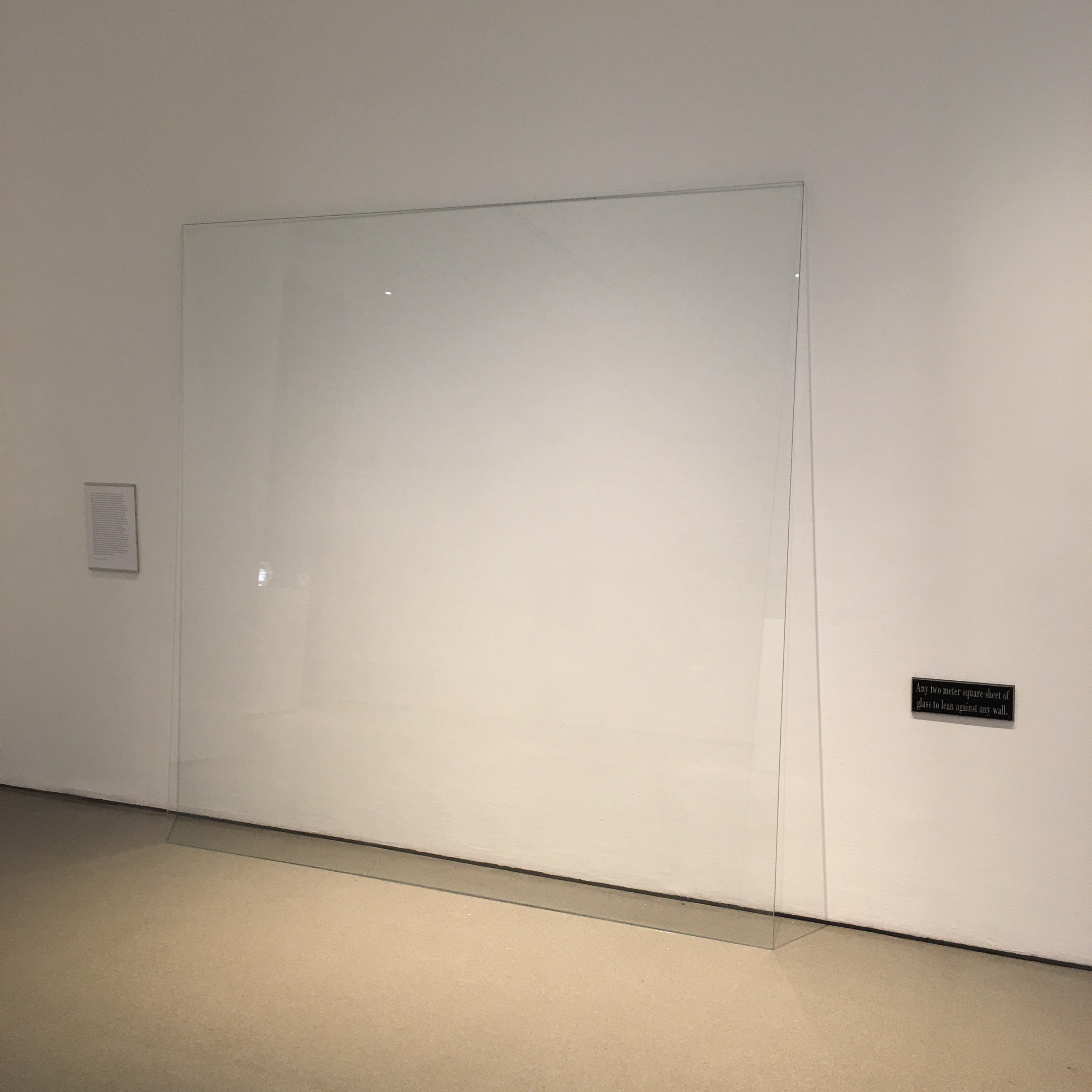
As an art student in the late 1970s I was introduced to conceptual art by the work of Joseph Kosuth. His work introduced me to semiotics, and how we construct meaning from what we see, how we develop preconceptions, how we understand what we think we know and how these thought processes stimulate the interpretation of the world around us. I was pleased to see his work included in the show and his work was the first and the last I looked at when I visited the exhibition. It was a great way to 'book-end' my visit and my reflections on the work of the artists represented. Often we are so seduced by the work of talented creators as we marvel at the incredible virtuosity and skills on display, that we forget to ask the simple questions such as what am I actually looking at? what are the materials used? What associations do these materials have for me? How have these associations been reinforced or subverted by what I have seen here? 
As I left the building my head was full of questions about the work I had seen and what they suggest to me individually and collectively, and I couldn't ask more from an exhibition.


Any two metre square sheet of glass to lean against any wall, 1965
- Joseph Kosuth


Monday, March 21, 2022

'No holiday', Hoan Kiem Lake, Hanoi, Vietnam

This recorded version of the performance 'No holiday' was conducted around Hoan Kiem Lake (Sword Lake) in Hanoi, Vietnam on 7th April, 2021.

Although overcast, it was a lovely warm day for a walk around the small lake in Vietnam's capital.

I walked anti-clockwise around the lake, beginning at the southern end close to Trang Thi and continued strolling slowly along until I had almost completed one full circuit of the lake.  

The film concludes as I continue on my way along Lai Thai To. 

A video of the performance is embedded below or, alternatively, you can view it on my Youtube channel.


Thursday, March 17, 2022

'British Summer Time: Season 6'

On Thursday 17th March Nina and I participated remotely in season 6 of British Summer Time walks organised by Dr. Blake Morris.

Season 6 of British Summer Time - Sunrise Walks will be experienced between 12th and 27th March, 2022. The season 6 project page can be found here.

The last time we had participated in this particular series of walks was in 2019, Season 1 of British Summer Time, on Wednesday 6th November and the write-up for that event can be found here.

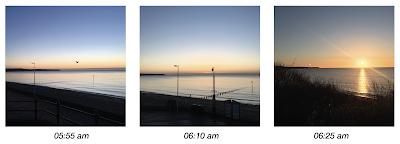
The listed time for dawn in Bridlington, East Yorkshire, UK was 06:10am and the three photos below were taken at the appointed times of 05:55am (15 minutes before sunrise), 06:10am (Sunrise) and 06:25am (15 minutes after sunrise).

As can be seen in the photos below, the sun wasn't visible until around 10-15 minutes after the official sunrise time due to a bank of low cloud over the North Sea. The morning was quite cool but as soon as the sun appeared it quickly made a difference to the temperature. We saw at least three rabbits out on the clifftops who, like us, appeared to be enjoying the morning sun.


Saturday, February 26, 2022

The Old Town to the Quay - Terminalia Festival 2022

Thankfully, this year's Terminalia Festival fell on a day that was blessed with bright sunshine, though the wind was still cool and sharp.

Previous walks on Terminalia have been: In 2019 a Saigon Citadel Walk and in 2020, a Saigon Canal Walk.

This one-day Festival of Psychogeography has been held every year on the 23rd of February since 2011 and brings together individuals and groups who mark the Festival of Terminus, the Roman god of boundaries and landmarks.

Nina and I were in Bridlington, East Yorkshire, UK to celebrate Terminalia by walking from the The Old Town to the Quay, via the Priory Church and we started at the top of Market Place at 11:00am promptly.

Originally the Old Town and the Quay were two separate locations, with the Old Town (Burlington) being the main area with the Quay forming the local port. More recently the two have merged to become the modern town of Bridlington.


A view through Westgate Park to The Avenue


Intriguingly named road


The official start of the walk


A view looking down Market Place in the Old Town, 
Burlington as it used to be known


Pillory (replica), first placed placed here in 1636


Stocks (replica), originals also c.1636


Unintentional Christo-influenced installation


Southern Hemisphere, bathed in sunlight


Beautifully proportioned shop-fronts


(Virtual) Shop-keeper waiting for customers


Unintentional Morandi-influenced shop window-display


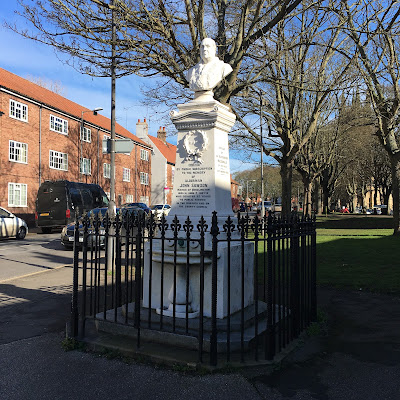
Bust of John Sawdon, Lord Mayor of Bridlington 1905-08
Disused drinking fountain


Bayle Gate, original gateway to the Priory.


The Church Green, Priory Church beyond


Remains of the old fencing around the Church Green


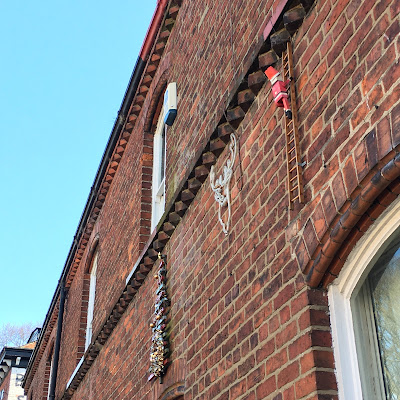
Christmas decorations, surviving into February


St. John's Burlington, Grade II listed Methodist Church


Surviving Cast-Iron Canopy on Quay Road


The arrival / departure of the train on the single line 
temporarily separates the Quay from the Old Town


Bridlington Centotaph


Repaired shrapnel damage from the Second World War


Even in February it is easy to find a bucket and spade for the beach


Plenty of multi-coloured sugar available


Modest monument to T. E. Lawrence,
unfortunately the gnomon is now missing


The Royal Yorkshire Yacht Club HQ appears ready to set sail


A view of the harbour with 'The Anchorman', 2015 
keeping watch (Sculpture by Ronald Falck)


This year's walk for Terminalia 2022 has been very enjoyable and we were very lucky with the weather. Who knows where next year's walk will be? We look forward to it.


Tuesday, February 22, 2022

'Experience Mapping' at 4WCoP 2021

The annual Fourth World Congress of Psychogeography was held this year on Saturday 4th and 5th September 2021. For this event Dr. Nina Yiu and I proposed a project we called 'Experience Mapping' that aimed to record the collective experience of participating in the congress. 


Maps are often depictions of actual locations, a record of the activities of a person or group of people, or even directions enabling someone to arrive at an intended location.

Rather than creating a map of the actual locations around Huddersfield University and its environs, we wanted to collate the experiences of different participants during the weekend, wherever they were, and combine them into a virtual map that could represent the collective experience of participants of the 'Experience Mapping' project. 

This approach required us to invite participants to take photographs of their activities sometime during the weekend of the congress and to send them to Nina and I, along with a note of the time the photograph was taken and a comment about the feeling at the time or a description of the environment. 

These photographs would then be transformed into drawn images and subsequently incorporated into a map that integrated the disparate elements into a seemingly logical map.

Nina and I presented the project concept on Saturday 4th September at 10:00am, and a recording of the presentation can be viewed below (or viewed at https://youtu.be/Ead6fwzgYY8)


Project presentation at 4WCoP 2021, 4th September 2021


Five people eventually responded to the open call by submitting photographs: Elspeth Billie Penfold, Sonia Overall, Aled Singleton, Steve Goldman, and Time Chapman. In total, we had twelve photographs to work with.

The first stage was to transform the photographs into graphic images by hand. As this process took some time, it allowed us gain a 'feeling' for the image and what was being captured, almost as if we were there ourselves, quite a lyrical approach we discovered. These days most of us are under pressure from deadlines and it is not often that we find ourselves with the luxury of patience. 

Being patient is sometimes what is required and in this project it was essential. The entire process was also unexpectedly delayed when fate intervened, and an unexpected family bereavement brought the process to a halt. It was several months before we were able to establish the correct frame of mind to retrace the previous thought processes.

As the images were created one-by-one, they were juxtaposed each time and a story gradually began to reveal itself as the images accumulated, and this emerging story became the guideline we used when composing the final map.

The 'Experience Mapping' project was a pilot project as it was the first time that it had been tried. There was inevitably a learning curve to negotiate within the process. In future, it is hoped, more complex maps would be attempted, if the opportunity arose.

Below are the twelve photographs used as the inspiration for the map, the twelve images transformed into hand-drawn images, and finally a screen-capture of the resolved map.


The twelve photographs submitted to the project


The twelve drawings created in response to the photographs


The final map as an A3 pdf


A recording of the congress final plenary session was made and can be viewed here, or below:


Monday, November 1, 2021

IFFTI 2021 - Fashion Resurgence: Our Time is Now. Conference Paper Presentation.

On October 28th 2021, Nina and I presented our paper: 'Weaving Experience Into Memory': A cross disciplinary project investigating the intersection of Art and Design at IFFTI 2021 at The Pearl Academy, India that was held virtually this year to the pandemic.

The annual conference is organised each year by The International Foundation of Fashion Technology Institutes and this year the conference was hosted by The Pearl Academy of India.

The abstract of the paper ran as follows:

‘Weaving Experience Into Memory’: A cross disciplinary project investigating the intersection of Art and Design. 


This paper outlines the initial stage of a collaborative research project that began with an artwork, its development into a fabric print design, the creation of a single test garment, and eventually a small collection of related wearable items presented in the form of a public exhibition in District 7 of Ho Chi Minh City, Vietnam.

The project that is the subject of this paper sought to explore several issues: can an artist and a fashion designer work efficiently and effectively together given the seemingly disparate nature of the two fields? What technical resources are available within the local industry here in Ho Chi Minh City?, and how could these resources be employed in order to reduce material wastage as well as manufacturing time and costs? In addition to this, could the project serve as a case study to inspire students?

In order to explore these questions the paper will detail the collaborative process beginning with the conceptual methods used in the initial artwork creation involving walking, observation, the collecting of data, the draft stages and the final digital art print. This will then be followed by a description of the test printing of various fabrics, natural and man-made, the sourcing of local digital fabric printing companies and the creation of an initial test garment. Following the description of this initial testing phase, the paper will then seek to describe the design and construction of the subsequent garments and wearable items for presentation and finally the curation of the public exhibition along with the compiling of the accompanying catalogue. 

As the collaborative process is unpacked, the paper will address issues such as sustainability, fabric wastage, 3D virtual prototyping technology and short-run fabric printing technology. The majority of these new developments seek to eliminate the wastage inherent in traditional iteration processes, for example, extended lead times and high sample numbers. The team consciously attempted to adopt a zero waste policy and exhibition items such as the parasol and the wooden information hangers were clad with any useable remnants of surplus printed fabric left over from the garment fabrication.

The resulting exhibition, forming part of the ‘Vietnam Festival of Creativity and Design 2020’, presented the entire creative process with reproductions of notebook pages, paper patterns, fabric samples, garments, footwear, a parasol and a video monitor screening computer simulated apparel designs and a 3D virtual fashion show with avatars wearing multiple variations of the designs on display. 


Keywords: Maker culture, cross-disciplinary design, 3D virtual prototyping technology, apparel simulation


A recording of the paper presentation can be viewed here. 


The IFFTI 2021 Conference website can be found here.


The full paper can be obtained upon request.


Friday, October 22, 2021

52 More - Score 11

'52 More' is a project created by Dr. Blake Morris and which follows on from his '52 Scores' project. The off-cuts of text left over from that previous work was now offered to participants so that they may use them to create scores that others could explore.

As I had greatly enjoyed participating in '52 scores', it seemed an easy decision for me to also participate in this new project. Of course, '52 More' involved taking responsibility for the compilation of a score, as opposed to following one compiled by others and it was this opportunity that attracted me.

To kick-start the process, Blake sent me an image and an assortment of short texts, sentences and phrases. As I was living in Vietnam at the time, the assortment was sent via email as opposed to the usual method via mail. 

Once I had received Blake's email, I printed out the various snippets of text, as well as his letter, and began playing around with them on top of the base image that appeared to be a sample paint card, featuring a variety of 'popular yellows', produced by Marquee Paint.

Following the instructions, supplied by Blake, I played around with the texts for almost a week, creating passages, disassembling passages, recreating alternate passages with the text, before finally deciding upon a configuration that seemed to present possibilities for exploration while at the same time retaining an element of the unknown, and perhaps some slightly absurd suggestions. At the end of the week I had arrived at the final score, which can be seen in the first images below:


The Final Score - 11

The walk took place on Sunday 29th August 2021. Blake walked in New York City - USA, Laura Phelps walked in Cardiff - UK, while Nina and I walked in Sewerby, East Yorkshire - UK. The three groups of walkers stayed in touch, exchanging comments and images via the 'Telegram' app. 

The final score text read as follows: 

The White House / yellows / are eligible only / After the Avant-Garde / cricket grounds - the Michael Carrick testimonial / Delivery / the magic of what is. / The explicit sociality we claim for The Walking / experiences / 'When is a Walk a Piece of Art? / Deep Listening / repeat the process


At the very start of the walk we found our first yellow, and with it the means to see our destination, a little further up the coast.


The cliff-top walk leads toward Sewerby, trees on the left, the sea on the right.


The first land-train platform, serving the model village.


More yellows: the remains of yesterday's fun-run.


The route markers were left for others but they became relevant for us too.


'The start', marking the entrance to Sewerby Park, the terminus of the land-train and the beginning of our cricket investigation.


We arrived at the land-train terminal platform but the train had already left. 
Heinrich Böll obviously never came here, and if he had perhaps he would have preferred walking too.


More yellows and more directional signage. This one hinting at the sociability of walking.


The largest yellow sign, announcing the destination cricket pitch at Sewerby.


Spectator seating surrounds the pitch, though today there were few takers.


...and some of those were from the insect world...


Varied refreshments await players and spectators alike, including copious rose-hips.


Further round the pitch I found a group of enthusiastic spectators, who came with their own wind-break.


A sight-screen...or minimalist construction?


The cricket match in progress, seen from the cliff-top side.


The cricket match in progress, seen from the pavilion side.


The rear of the pavilion. Another minimalist construction, this time in yellow.


Cricket nets, this time referencing Do Ho Suh?.


We finally sighted the White House, nestling in the trees, beyond the ha-ha.


A local bee enjoying post match refreshments.


We found a fairy ring near to the practice pitch.


Guard dog? or petrified companion?


Picking up more yellows in the local hedgerows.


Being observed whilst observing...


Deep listening, echoes of the park band reverberate only in our imagination.


At the end of the walk, we found ourselves in time to catch the land-train. However, we turned down the offer. Why ride when we could walk?


For more details and observations about Score 11, please see Blake's project blog here. If you would like to create a score or participate in scores created by others, please contact Blake directly via the details on his website.